
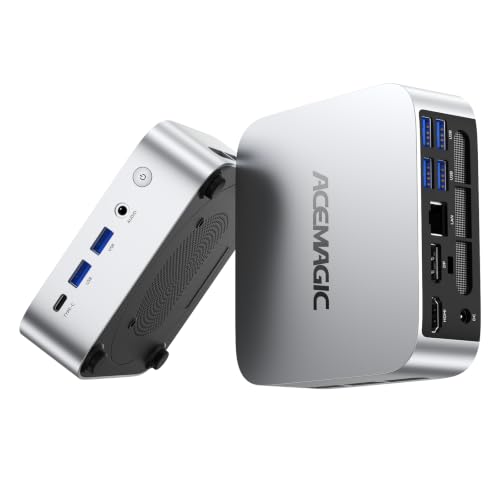
ACEMAGIC Everyday Mini PCs: V1 and K1
Everyday mini PCs are for the jobs most computers spend their lives doing: email, documents, spreadsheets, browsing, video calls and streaming. They use low-power processors, so they're compact, sip electricity and cost far less than performance models. ACEMAGIC's two options here take different routes. The V1 is as small and simple as possible, while the K1 trades a slightly larger case for more ports, three screens and room to upgrade.
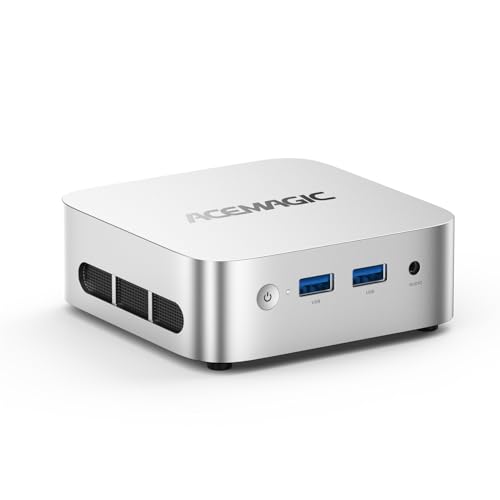
The two models at a glance
- ACEMAGIC V1: Intel N150 (4 cores / 4 threads), 16 GB DDR4, 512 GB, Wi-Fi 6, two 4K outputs, 100 × 100 × 33 mm, 30 W adapter.
- ACEMAGIC K1: AMD Ryzen Embedded R2544 (4 cores / 8 threads), 16 GB DDR4, 1 TB, two memory and two drive slots, six USB-A ports plus USB-C, three outputs, Wi-Fi 5.
How to choose an everyday mini PC
Be honest about your workload. If you mostly use a browser, office apps and video calls, either model will do. If you keep dozens of tabs open next to large spreadsheets, the K1's eight threads give more headroom than the V1's four.
Count your screens. The V1 drives two 4K 60 Hz displays over HDMI and DisplayPort. The K1 adds USB-C for a third, though ACEMAGIC's Japanese page notes that three screens at once run at up to 4K 30 Hz. For two monitors, both are fine.
Count your peripherals. The V1 has four USB-A ports, two at 10 Gbps and two at USB 2.0, and no USB-C. The K1 has six 5 Gbps USB-A ports and a USB-C port. If you connect a printer, webcam, drives and a card reader, the K1 avoids a hub.
Think about upgrades. The V1 has a single memory slot already filled to its 16 GB maximum and a single drive slot. The K1 has two memory slots up to 32 GB and two M.2 slots up to 4 TB, so it can grow with you.
Consider wireless. The V1 has Wi-Fi 6 and Bluetooth 5.2; the K1 has Wi-Fi 5 and Bluetooth 4.2. If your router is far away or you use many Bluetooth devices, the V1's newer radio helps. Both have Gigabit Ethernet.
Weigh size and power. The V1 is 100 mm square and uses a 12 V / 2.5 A adapter. The K1 is 128.2 mm square and uses a 19 V / 3.42 A adapter, but comes with a VESA mount for the back of a monitor.
Check the exact version. ACEMAGIC sells the V1 with N95, N97 and N150 processors, and the K1 in 8 GB / 256 GB and 16 GB versions. Some included drives are SATA rather than NVMe. Check the processor, memory and drive on the product page before you order.
Quick picks
| If you want... | Choose |
|---|---|
| The smallest, simplest PC | V1 |
| Newer Wi-Fi and Bluetooth | V1 |
| Three monitors | K1 |
| More USB ports and USB-C | K1 |
| Room to add memory and storage | K1 |
FAQ
Are everyday mini PCs good enough for home offices? For email, documents, browsing and video calls, yes. They're not designed for gaming or heavy photo and video editing; look at our performance mini PCs for that.
Can they stream 4K video? Both list 4K 60 Hz output, which covers 4K streaming on a compatible display.
Are they quiet? Low-power processors generally run cool and quiet, but ACEMAGIC doesn't publish noise figures for either model.
Which is better for a small business front desk? The V1 if space is tight and you only need two screens. The K1 if you need a receipt printer, scanner, card reader and other USB devices plugged in at once.
Do they come with Windows? Yes, both ship with Windows 11 Pro.
For the full lineup, read the ACEMAGIC review, or see how the V1 stacks up in ACEMAGIC V1 vs Beelink EQ14.